
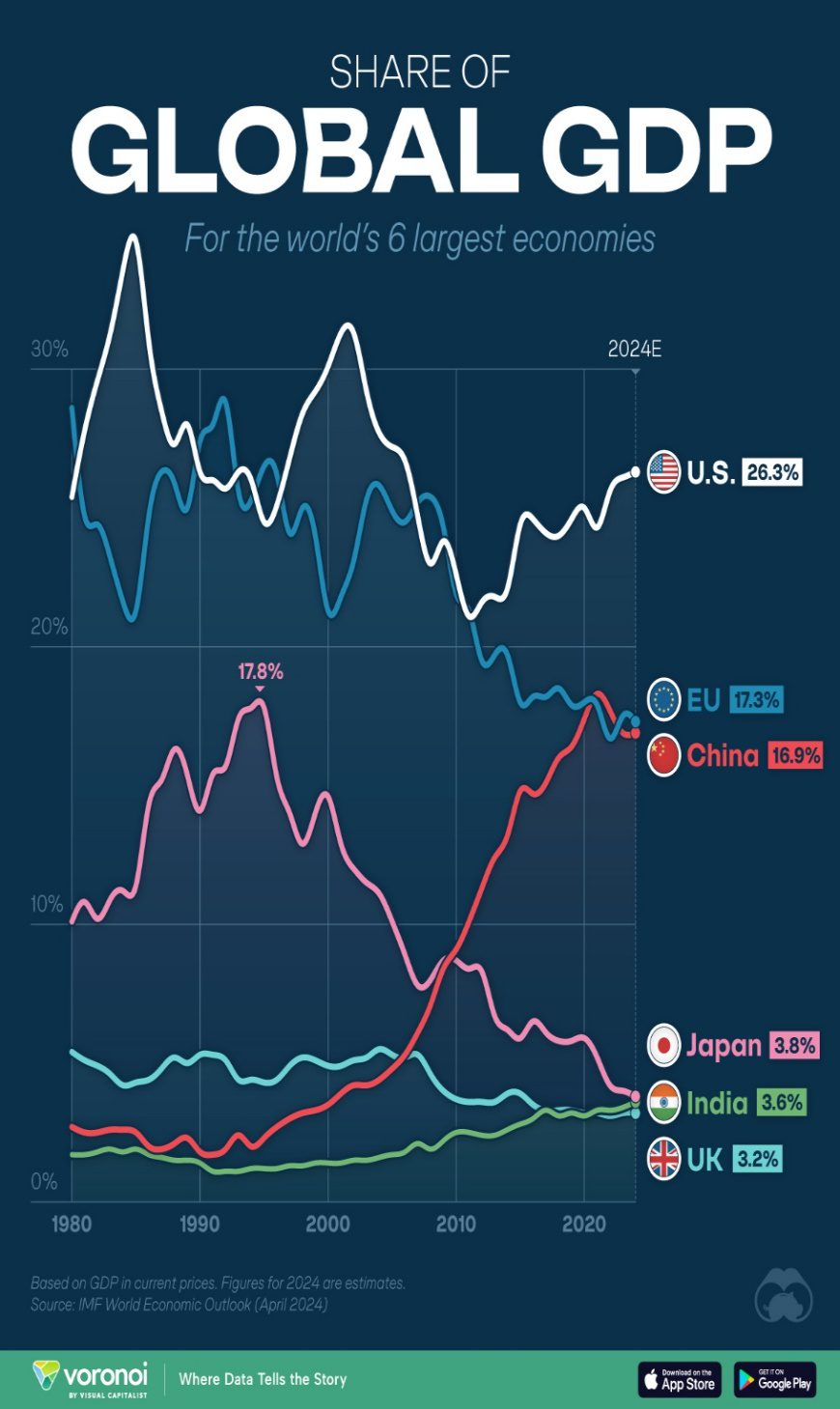
The remarkable separation between the U.S. and the European Union economies since 2000 is evident in this graph. Let’s explore the challenges we have in sustaining our U.S. growth. We must be very careful. U.S. growth has been dramatically affected by six annual $2-3trillion-dollar deficits. Can we sustain this level of debt-financed spending? We cannot.
The graph compares the U.S. to the E.U. There were times, as recently as 2008, when the E.U. exceeded the U.S. in its share of global GDP. However, since about 2011, the U.S. has grown while the E.U.’s growth has fallen. The chart shows that the E.U. has shrunk to 17.3% of Global GDP, while the U.S., with higher growth, has climbed to 26.3% of Global GDP.
The challenges:
1. Our misguided plan: The game plan is that deficits do not matter (but they do), and that the government will know when to quit spending just in time to avoid significant inflation (but they did not). Whose idea is that? People who believe in Modern Monetary Theory believe that strong governments can print and spend money without danger. Our economy has passed that danger point and has had inflation, with no slowdown in debt spending or renunciation of MMT.
2. Why do we have such deficits? High spending for Covid has put some benefits at new elevated levels that benefited more people and still do. The Inflation Reduction Act was an open-ended commitment to environmental priorities that have sent billions to those new priorities. Entitlements are already familiar to us.
3. Governments find it difficult to measure outcomes. So, the more people we cover, and the more money we spend, must mean more success. This is the opposite of a business model that requires outcomes. Environmental or educational outcomes may be minimal (even negative) but it’s ok because ‘we spent more.’
4. Competence makes a minor difference. Governments talk about priorities while businesses talk about profits. If we measure competence by priority spending, then competence in outcomes matters little.
5. The Fed has kept interest rates low, until lately, but this is not normal, and it does not provide a return for those who loan to governments or businesses. We are supposed to be happy if we get our money back without any real (inflation-adjusted) income. Debtors love this, especially Uncle Sam, but the era of near-zero interest rates may finally (20-year bond just touched 5%) be ending (I’ve been wrong on this before).
6. Congress has the unusual problem of passing very few bills and is not doing its job as we all know.
7. An imperial presidency, along with a paralyzed Congress, is unsustainable and even harmful. Presidents, since Obama, have expanded the ‘power of the pen’ for executive orders to get things done.
This week’s effort in Congress to continue the 2017 Tax Cuts will either spur growth or it will just cut taxes for the IRS-tax-paying half of Americans. Yet we hear news that is as useless as the sound of waves lapping on a beach. We need to consider the ‘currents’ and navigate accordingly.
Focusing on economic growth is effective. Mississippi now has a greater GDP per capita than France. Why? MS, like the turtle, grew enough to catch the stalled French rabbit. Growth matters. Whatever grows the economic pie is preferable to whatever may, even legitimately, redistribute that pie. Ask Europe.
In other areas, the universities are facing declining enrollment numbers, poor prospects in each foreseeable year, and a strange commitment, among the elite schools, to tolerating or denying the evil of antisemitism. The Federal Reserve, though they have made real mistakes, are still the only adults in DC. The president’s use of tariffs, reorganization, and foreign diplomacy has been disruptive, but the net effects are far from certain. Repairing our errors and focusing on growth is the economic path forward. A good start.