
I have two surprises today. One is real. The other, in my opinion, is false.
1. Let’s start with Europe: You may have heard that America’s poorest state, Mississippi, has per capita GDP greater than that of France. It’s true. In fact, the IMF reports that the Eurozone’s per capita GDP is lower than that of every U.S. state except Idaho and Mississippi. How can that be? (WSJ July 23, 2023)
France, after WW2, had a growth spurt that lasted 30 years (Les Trente Glorieuses). During that time, France not only rebuilt what the war destroyed but also modernized everything. It was wonderful. When the 30 years of catch-up time were over, so was the growth. France, along with all of Europe, fell behind in preferring government spending (avg 45% of GDP) to economic growth. More recently, since 2008, the entire Eurozone has grown at a total of 6% while the U.S. economy, having chosen growth, has almost doubled, growing by 82% (government spends 27% of GDP) (WSJ). That’s how once-impoverished Mississippi finally overtook France in per capita GDP.
Mississippi? A long-term perspective surprises us because we are so used to the brief news cycle. Since 1990, the global increase in people escaping extreme poverty has been amazing, but today I’ve chosen to focus only on rich countries. Over time, growing the ‘economic pie’ makes it possible for even Mississippi to escape poverty.
2. A few say the U.S. is also very poor: As surprising as the relative poverty of Europe may be, it is shocking to read those who claim that Americans are impoverished. That harm comes from our relative (that’s the key word) income or wealth compared to the very richest. France has only 42 billionaires; the U.S. has 724; Europe has 355. (Forbes 2021). I want to explore what I see as the odd thinking of those who say, apparently sincerely, that billionaires actually cause poverty by hogging a bigger piece of the pie. Here’s how they figure it. Hang on.
Imagine, in 1975, that a school teacher earned $7,500 and had a pension and savings totaling $25,000. The richest person in her county had an income of $250,000 and had a total wealth of around $25 million. The school teacher made 3% of that of a high-income person and had wealth equal to 0.1% of the wealthiest. We can measure economic (and only economic) well-being or poverty using those numbers. (The chart will help keep this straight)
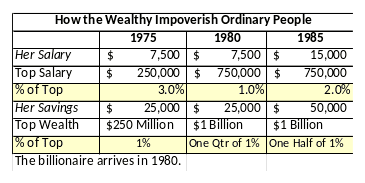
Then, in 1980, a $1 billionaire moves to town. That billionaire is paid a total comp of $750,000 annually. Now the school teacher earns 1% of that highest salary ($7,500/$750,000) instead of 3%. That’s a two-thirds reduction in her salary. Since the billionaire has four times the wealth of the formerly richest person, our school teacher’s savings had declined to one-fourth of the share it was before. A ‘reduction’ of 75% of her wealth. That new billionaire caused her to ‘lose’ 75% of her wealth and 67% of her salary in relative terms, affecting her and everyone who isn’t a billionaire.
In 1985, she doubled her salary and savings. Now she’s making $15,000 or 2% of that billionaire’s salary. Her savings and pension have doubled to $50,000, but it’s a smaller percentage of the new billionaire’s wealth.
Here’s the point. Some claim that a billionaire, by moving to town in 1980, harmed our teacher relative to her situation in 1975. However, doubling her wealth and income in 1985, in their view, still left her worse off in relative terms than she was in 1975. Did Tiger Woods’ incredible winnings impoverish other pro golfers?
How? At $25,000, she earned 3% of the former top-paid person, and now, after doubling to $50,000, she’s making only 2%. As for savings, she lost half of her share of the former wealthiest’s wealth. If you make poverty relative and increase the top wealth, everyone is worse off in relative terms, even if their salary and savings
double. This is the bunkum that comes from defining income only in relative terms. In the real world, school teachers, business owners, factory and office workers, and immigrants are much better off in a wealth-creating society like Mississippi, regardless of others’ contrary opinions, though extreme wealth has its issues. In a fixed pie/limited good society (think Middle Ages), the rich did harm the poor. Our modern bounty grows the pie.
What do we learn from Europe? That growth is the most important contributor to economic well-being.
What do we learn from our school teacher? That the relative wealth method can be abused to demonstrate something we know is not so. Have the orthopedics in K-county harmed us? Of course not. Income inequality is a legitimate issue, but it is much less so when handled by people with such a distorting perspective.